Most CO2 machines in the Indian market are sold on a single number: maximum watts. That number is the least informative thing on the sheet.
Why the source decides the machine
The source determines power stability, pulse consistency, beam profile, starting reliability, operating life and how repeatable a treatment is from one day to the next. Everything downstream — arm, scanner, software — can only preserve or degrade what the source produces.
Ask the vendor to identify:
- Source manufacturer
- Source model
- Source type
- Serial number
- Rated output
- Date of manufacture
- Warranty on the source specifically
- Expected service process
- Replacement availability
What a named source specification looks like
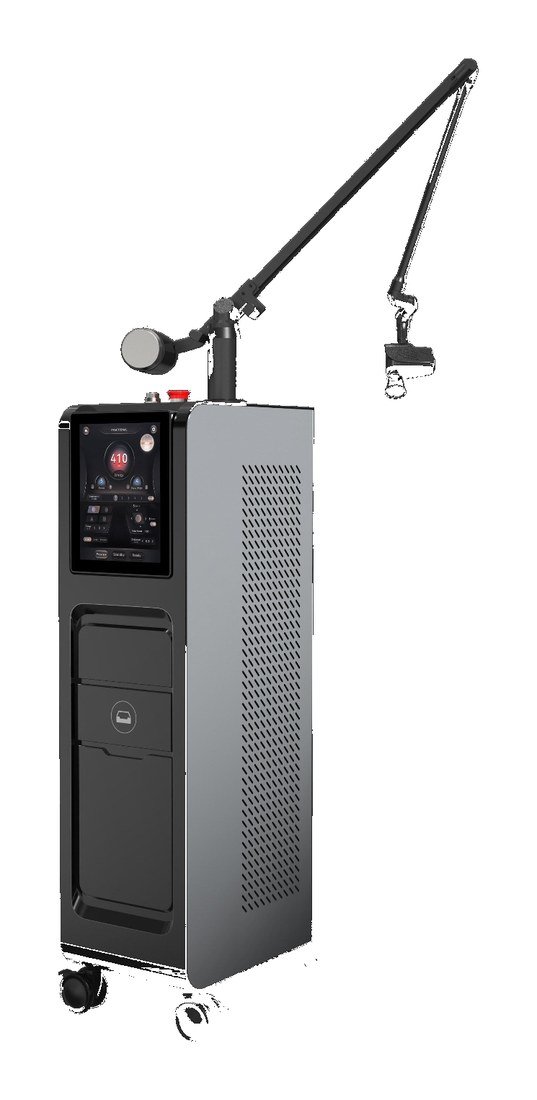
This is the source specification for the metal RF tube platform we supply, published so you have something concrete to compare a quotation against.
| Parameter | Specification |
|---|---|
| Source | US Synrad RF metal tube |
| Rated output power | 60 W |
| Wavelength | 10.57–10.63 µm (9.3 µm optional) |
| Beam mode | TEM₀₀, M² ≤ 1.2 |
| Beam ellipticity | < 1.2 |
| Emitting spot diameter (1/e²) | 2.8 ± 0.5 mm |
| Full-angle divergence | ≤ 7 mRad |
| Polarisation | Fixed horizontal linear, extinction ratio > 100:1 |
| Power adjustment | 0–100%, linearly adjustable |
| Long-term power stability | ±3% after 2-minute thermal stabilisation |
| Cold-start stability | ±5% to ±10% |
Every line above is a number a competing quotation can be measured against. If the machine you are comparing cannot produce an equivalent table, that is the finding.
How to read the numbers
| Parameter | What it tells you |
|---|---|
| M² (beam quality) | How close the beam is to ideal. A lower figure focuses to a tighter, more predictable spot |
| Beam ellipticity | Whether the spot is round or oval. An oval spot treats unevenly across its axis |
| Divergence | How much the beam spreads. High divergence costs you energy and spot definition at the tip |
| Power stability | Whether shot fifty matches shot one. This is repeatability, which is what a protocol depends on |
| Cold-start stability | How the machine behaves before it warms up — and therefore what your first patient of the day receives |
| Linear power adjustment | Whether the setting maps predictably to output across the range, or only near the top |
Why 60 W is not a specification
Maximum wattage is a ceiling, not a description of behaviour. Two machines rated at the same wattage can differ in beam quality, stability, pulse structure, transmission losses and calibration — all of which change the energy that reaches tissue.
The useful comparison is:
- Is the source named, with parameters?
- Is stability specified, and over what warm-up period?
- Is the output measurable with a calibrated meter during the demonstration?
- Does the arm's transmittance figure exist? Arm and scanner
- Does the pulse structure come from the source, or from the software menu?
Frequently Asked Questions
Which laser source is in your CO2 machine?
A US Synrad RF metal tube rated at 60 W, specified at TEM00 with M2 <= 1.2, beam ellipticity below 1.2, emitting spot 2.8 +/- 0.5 mm, divergence <= 7 mRad and long-term power stability of +/-3% after a two-minute warm-up.
What is M2 and why does it matter?
It is a measure of beam quality - how close the beam is to ideal. A lower M2 focuses to a tighter, more predictable spot, which matters more than maximum wattage.
Why does cold-start stability matter?
It describes how the machine behaves before it is thermally stable, which is what your first patient of the day actually receives.
How do I verify a vendor's power claim?
Ask for the source manufacturer, model and serial number, and ask for the output to be measured with a calibrated laser power or energy meter during the demonstration.
Is a glass tube the same as an RF metal tube?
They are different source types with different service and lifetime characteristics. Ask which one is fitted and what the replacement process and cost are.